
When AI Creates a Luxury Campaign: The Zimmermann Project
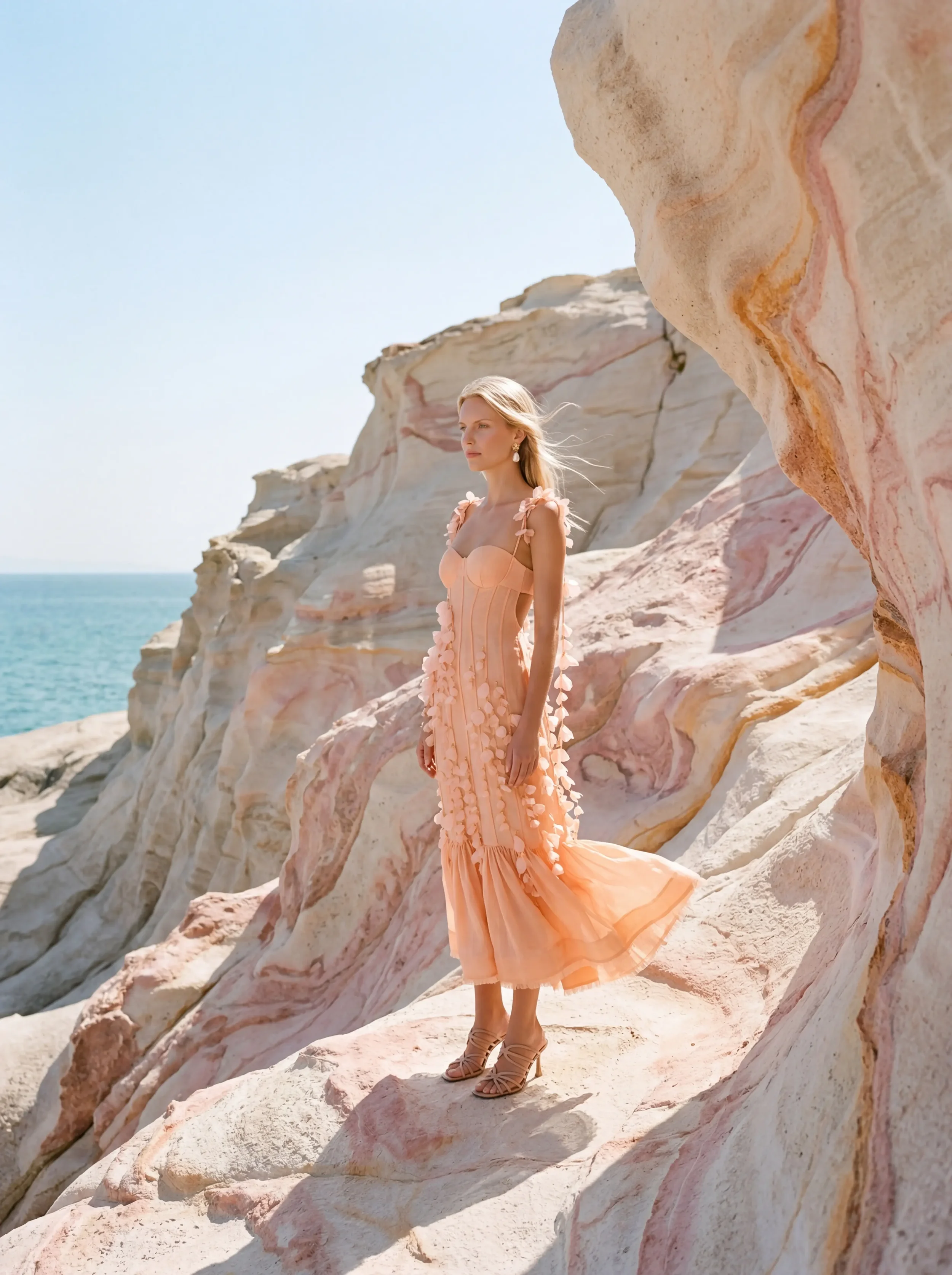
Limestone rocks that look like pink marble.
A peach-colored dress that blends in with the stone until you really look at it.
The turquoise waters of the Mediterranean in the background.
Nothing you see in this article has ever existed outside of an artificial intelligence model.
And yet it seems so real that it makes you want to book a flight.
The Brief: A Zimmermann Campaign That Can't Be Filmed
The starting point was deliberately ambitious: to recreate the aesthetic of a Zimmermann campaign—an Australian brand known for its romantic femininity, artisanal craftsmanship, and dreamy Mediterranean settings—without leaving Florence, without a production budget, and without a crew.
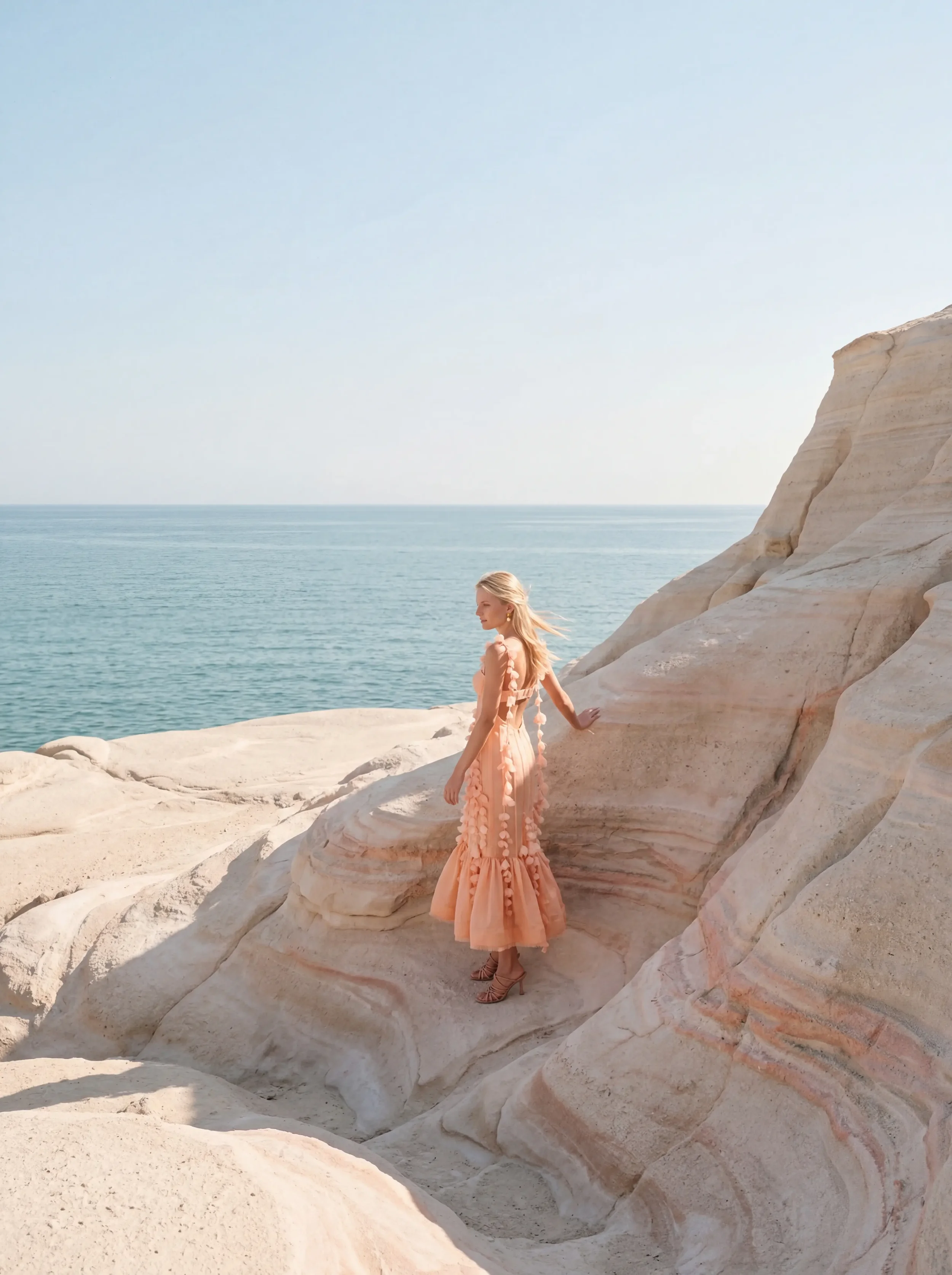
The imaginary brief was precise: limestone rocks with pink veins, the low light of late afternoon, a peach-colored chiffon dress with floral appliqués, a blonde model with her hair blowing in the wind, and a blurred turquoise sea in the background. An aesthetic straight out of a *Vogue Australia* editorial, with that tension between untamed nature and sartorial sophistication that Zimmermann knows how to evoke better than anyone else.
All of this was generated entirely by AI—from the model to the dress, from the rocks to the light.
Why Zimmermann as a reference
Zimmermann is one of the hardest brands to replicate visually, precisely because its strength lies not in technical perfection butin the authenticity of the light and the setting. Their campaigns always seem to have been shot in the right place, at the right time, with the right model—not staged, but discovered.
It was the ideal test case for generative AI: if you can convince the eye that that light is real, that those rocks truly have that texture, that that dress really moves in the wind, then you’ve demonstrated something important about the level artificial intelligence has reached in the visual production of fashion.
“It’s notabout deceiving. It’s about demonstrating that AI has reached a level of aesthetic understanding that allows it to evoke real emotions with images that have never existed.”
How This Campaign Was Built
Generating editorial-quality fashion images with AI isn't just a matter of writing a prompt and hoping for the best. The process requires precise artistic direction, controlled iterations, and a deep understanding of how generative models interpret light, fabric, anatomy, and photographic composition.
-
Analysis of Zimmermann's Aesthetics: color palette, type of location, dress features, model's style, and photographic mood.
-
Creating prompts for each element: lighting, composition, pose, fabric details, rock textures, and depth of field.
-
Generating dozens of variations for each shot, selecting the versions with the greatest visual consistency and emotional impact.
-
Align all shots in terms of color palette, lighting, and style to create a visually cohesive campaign, not just a collection of isolated images.
Reading Images: What AI Did Right
When you look at the photos with a critical eye, a few things stand out that the AI handled surprisingly well.
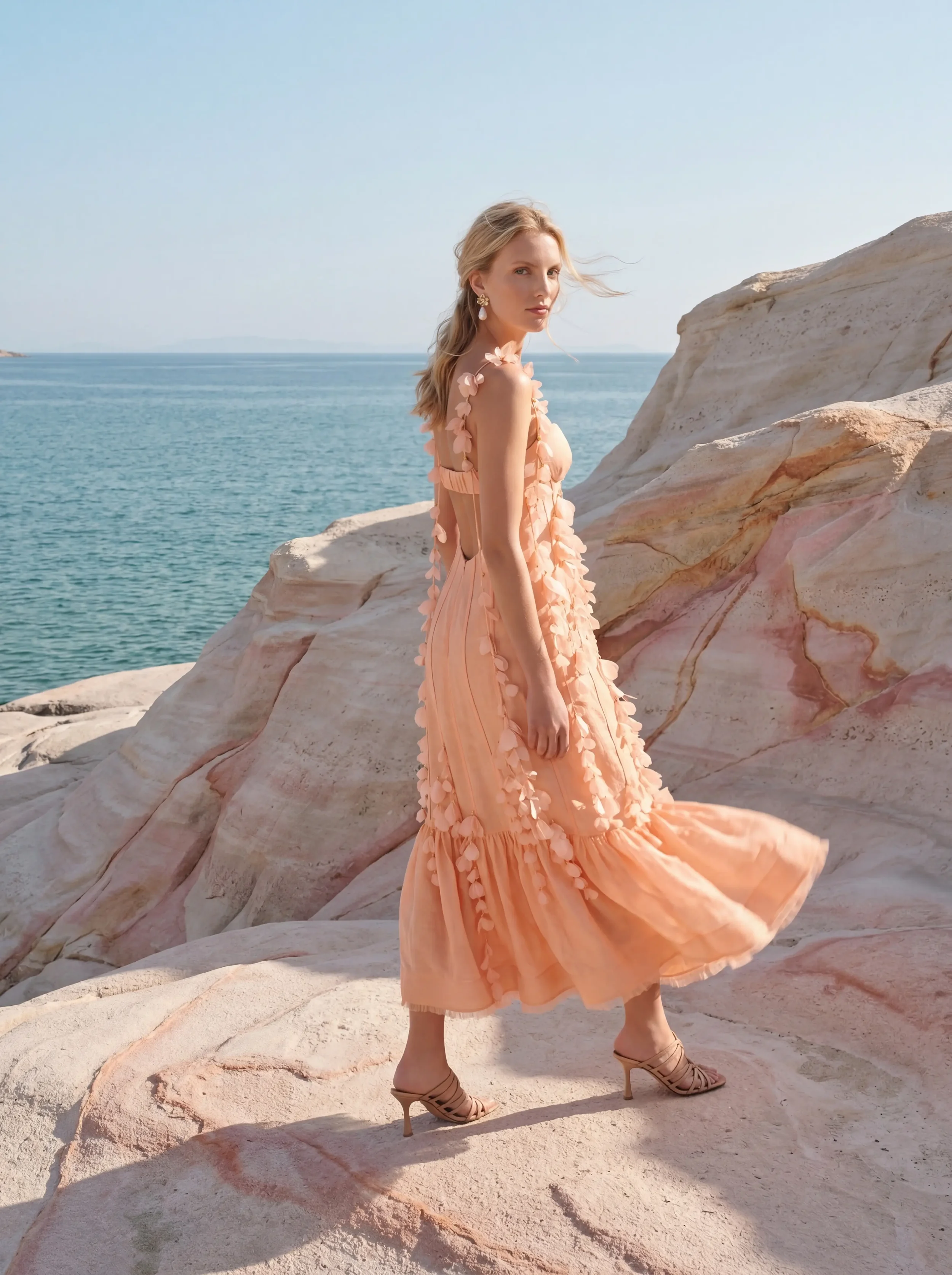
The color harmony is perhaps the most striking result: the peach hue of the dress complements the pink-orange veins of the limestone rocks perfectly, while the cool turquoise of the sea balances the warm tones of the scene. This is no coincidence—it is the result of a prompt designed with that color palette as its central element.
The quality of the light is impressive. The AI recreated that low-angle late-afternoon light that casts soft shadows on the rocks and makes the chiffon shimmer without overexposing it—the very light that cinematographers spend hours chasing on set.
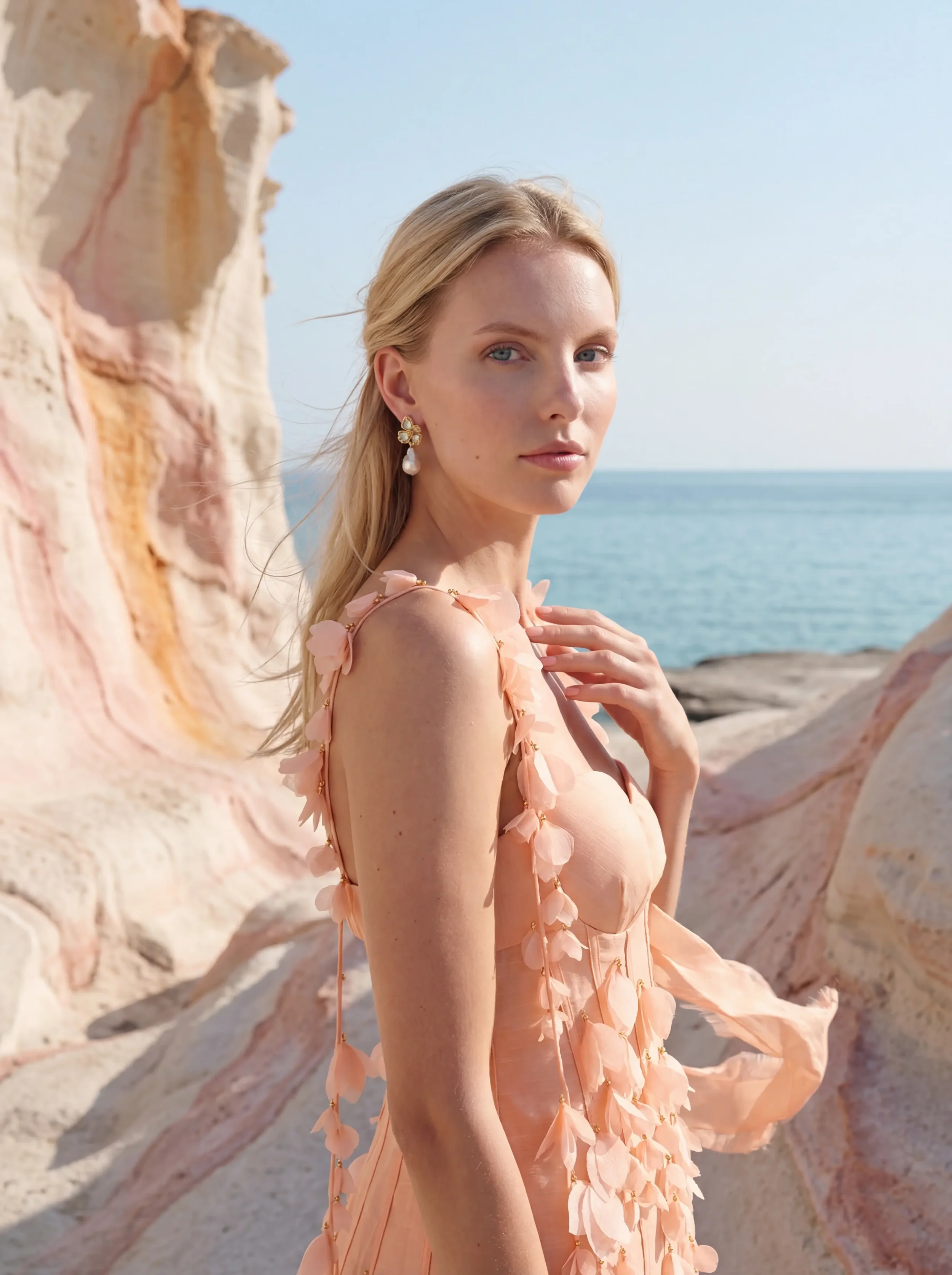
The fabric details, the floral appliqués, the flow of the chiffon, and the corset-style construction of the bustier are rendered with a level of precision that, until recently, would have been impossible for a generative model.
The Limits That Still Exist
Transparency requires us to also point out what didn't work perfectly—or rather, what still needs attention in AI-generated content of this caliber.
Where AI Still Requires Supervision
Ensuring facial consistency across different shots requires advanced identity consistency techniques; without them, each image may feature a slightly different model.
Hands and fingers remain one of the most challenging areas for generative models: they must be handled with care when it comes to framing and posing.
Text and graphics overlaid on AI images tend to become distorted; all lettering must be added in post-production
The physics of moving fabric has improved tremendously, but it can still produce unnatural results on very complex garments
What does this mean for fashion brands?
A campaign like this—four high-end editorial shots featuring a Mediterranean location, a model, and a tailored dress—would have required a budget of between 40,000 and 120,000 euros under a traditional production model, covering location scouting, flights, hotels, crew, equipment rental, and post-production. Timeline: three to six months.
With AI-generated production, turnaround times are measured in days, and costs are a fraction of that budget. And most importantly: you can visually test a concept before investing a single euro in actual production, explore dozens of color palette and location variations without leaving your seat, and produce materials for different markets with quick adjustments.
This does not eliminate traditional photography; there are contexts in which the authenticity of a real photograph is indispensable. But it opens up a new category of visual production that simply did not exist before.
“Thequestion is no longer, ‘Can AI create luxury fashion?’ These images speak for themselves. The question is: How do you integrate this tool into your creative strategy?”
Leggi anche: Come creare una campagna moda con AI · Fashion marketing con intelligenza artificiale · Il servizio Visionary Campaigns
Edited by Alicia Sabatino, Creative Director of AI Fashion Company
